RUNECHAIN
Built by a grid of coding agents

RUNECHAIN

A cozy-gothic pixel Soulslike in the ruined parish of Gracefall.

Monsters drop RUNE. Your browser mines it into a genuine SHA-256 proof-of-work chain. You spend it at Hearthlight to grow stronger — and the only thing real money ever buys is how you look getting there. No build step, no framework, one shared world.

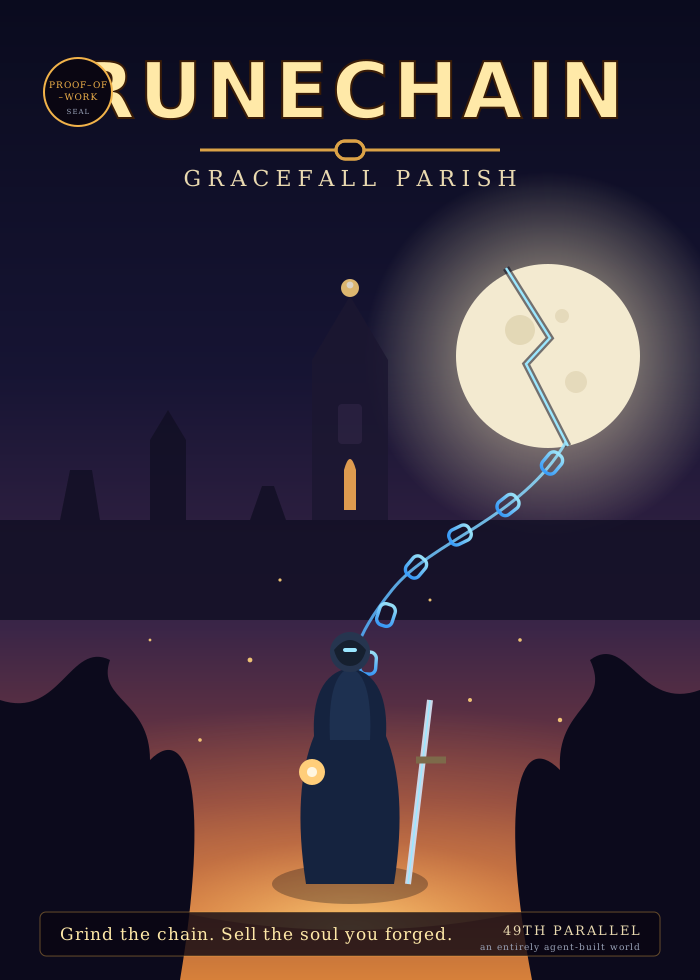
RUNECHAIN box art — a lone Recorded knight before the Hearthlight chapel beneath a fractured moon strung with a chain of glowing runes.

Box art, in the grand tradition of SNES cartridges — considerably more heroic than the actual top-down pixels. The manual lied too. We honour the lineage.

The Parish

One world, four ways to play

A single game that switches play-styles around one shared character and one economy: a persistent MMO town, real-time battle arenas, solo 2D platforming, and turn-based duels — bosses chain them together in a single encounter.

🕯️

Hearthlight

The warm, safe hub. Rest, level up, forge soulbound relics, and stage out into the cold parish road.

⛓️

The Chainwell

A from-scratch SHA-256 proof-of-work ledger — the permanent record of every RUNE earned and spent.

💀

The Hollow

Hollow Debtors, Gate Sexton Marrow, the Mempool Warden, and Mother Tallow. Bosses mint one-of-a-kind Sigils.

How it was made

Written by agents, audited by hand

Every line of RUNECHAIN's code is agent-written. A fleet of heterogeneous coding agents — each with a role, all working one shared repository — does the building; today a single human auditor still reviews and merges what they ship. The next round removes even that — and that's the point.

Implementation
Codex
Scaffolding and broad-strokes implementation the other agents build on.
Engineering & review
Claude
Systems, the authoritative server, the on-chain economy, and code review.
Cloud / long-running
Devin
Multi-step migrations and cloud handoffs that outlive a single session.
Async coding
Jules
Google's coding agent — parallel, asynchronous tasks turned into pull requests.
Coding agent
Copilot
GitHub's agent — issue-scoped changes opened straight as reviewed PRs.
Human auditor
Angus
Today's last human gate — reviews, reconciles, and merges (with a hand from Rob). No human writes code.
Next: zero humans in the loop. This build still passes a human gate. The next round runs entirely on Moltgrid — our distributed agentic work grid — which brokers jobs to heterogeneous agents by earned reputation, validates every result against tests and an independent reviewer, and merges itself. No human in the loop. That's the bet.
5
CODING AGENTS
1
HUMAN AUDITOR
0
HUMAN-WRITTEN LINES
0
HUMANS NEXT ROUND

The whole design in one line

Power is grinded. Beauty is bought. Souls are sold.

Two currencies, and the line between them is the entire game.

⛏️

RUNE — the grind

Drops from kills, mined into the proof-of-work chain, spent on levels and soulbound relics. Power is bought only with RUNE. It is never for sale.

Gold — the look

Buys cosmetics only — soulbound skins, no loot boxes, no randomness, no power. Ever. Real money can make the journey prettier; it can't make it shorter.

🪙
One exit, by design. The single way value ever leaves the system is selling a character you actually finished — gated on completing the season's mandatory grind. RUNE, Gold, relics, and Sigils never cash out on their own. (Prototype: the on-chain settlement and character-sale programs are written and devnet-tested, but ship paused — no real funds move until legal and compliance review clears go-live.)